

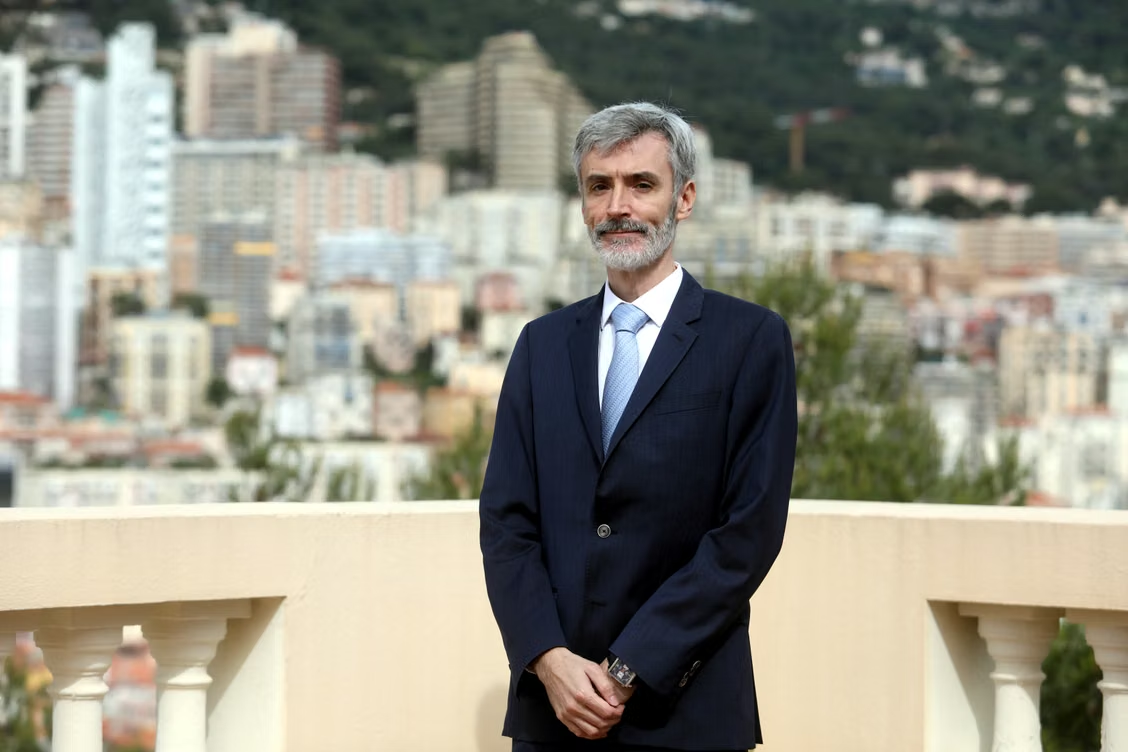
Frédéric Cottalorda, Monaco's newly appointed Minister of Finance and Economy, says the principality has moved past the phase of designing reforms against money laundering and terrorist financing and now has to prove those reforms hold up over time. Cottalorda, who spent more than a year working alongside his predecessor Pierre-André Chiappori before taking over the post, called the appointment an honor and said the overlap gave him a head start on the technical files awaiting him. Of the government's own reform record, he put it simply: "We must show that our reforms produce lasting results."
Getting Monaco off the Financial Action Task Force's grey list remains the government's top priority, and Cottalorda argues the principality has already addressed nearly every point on the FATF's checklist, leaving enforcement as the main outstanding question. He pointed to a recent six million euro fine against UBS Monaco as evidence that sanctions handed down by the independent Monegasque Financial Security Authority are working as intended, calling them proportionate rather than excessive and meant to warn other financial professionals that breaking the rules carries a real cost. He downplayed expectations for a plenary FATF meeting scheduled in Paris in June, saying it was too soon to expect an exit and that the decision now rests with the FATF itself.
On the budget, Cottalorda framed his approach as reconciling the caution and ambition the Minister of State called for when presenting the 2026 draft budget in December. With the exceptional tax revenue generated by major property developments such as Mareterra and Testimonio winding down, he said the government is looking to diversify its growth drivers rather than lean further on real estate, tourism, business conventions and the financial sector alone. Private equity is one area under consideration, a niche he said has produced strong results in Luxembourg and the Channel Islands, alongside a bill planned for 2027 to strengthen the state's ability to recover unpaid debts.
Cottalorda also addressed criticism from the National Council over budget overruns, which the Minister of State himself described as a threefold failure, saying projects will be monitored more closely and scoped more carefully before launch. On the spending side, he defended the government's one percent salary and pension increase for civil servants, a two point four million euro measure he said was meant to protect purchasing power against inflation rather than a one time gesture, and said officials are working to keep the popular Carlo consumer app financially sustainable by rebalancing technical fees between the state and participating businesses.
Asked about Monaco's shifting trade patterns, Cottalorda noted that commerce with the EU outside France has declined while trade with Asia has grown, a shift he linked to businesses and the state alike looking for markets with stronger growth. He also said tourism has picked up some visitors who might once have chosen Gulf destinations amid regional instability, and that the principality is not ruling out attracting new residents seeking security and stability, even as he cautioned that the broader economic impact of Middle East tensions on Monaco has so far stayed limited to higher fuel costs.